15 minutes to a reading
HMB X Rapid Bacterial Testing
A handheld instrument that reads how much biological activity is happening in your coolant right now, in the time it takes to walk the shop floor and back.
Two ways to read a sump, and they answer different questions
Bacterial contamination in a metalworking fluid shows up as offensive odors, corrosion, shortened tool life, and a real health risk to whoever is standing at the machine. There are two ways to find out how bad it is. A growth or plate count estimates a density of organisms, reported as colony forming units per milliliter, with a result you get back in twenty four to seventy two hours and a published precision around plus or minus 30 percent. HMB is biochemical. It measures activity, not a population count, reports a result in about fifteen minutes, and its published precision is around plus or minus 3 percent. In BioTech's own words, activity and counts are not the same measurement. Both are useful, often complementary, but in a given system there may or may not exist any useful correlation between them. Neither method is the wrong one. They just are not interchangeable.
What the reagent is actually doing
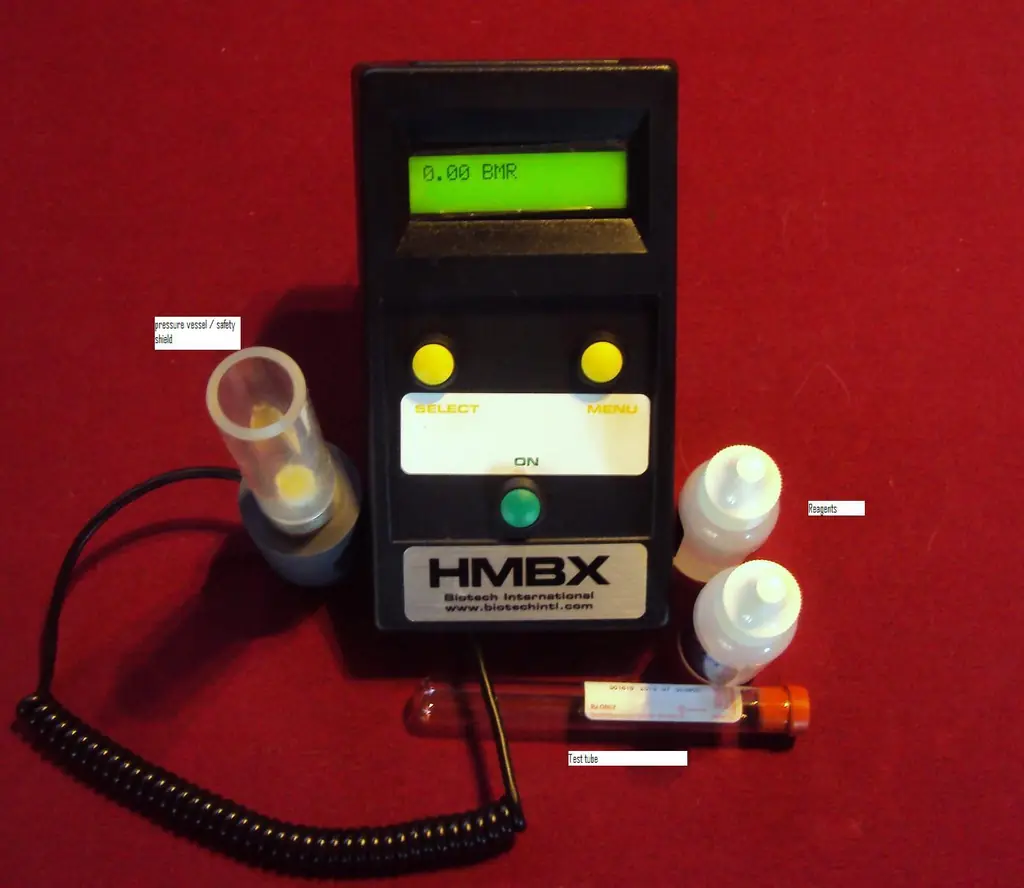
Aerobic organisms produce enzymes called peroxidases while they metabolise, in proportion to how active they are. The HMB reagent reacts with that peroxidase and releases oxygen. The instrument measures the oxygen and converts it into a Biomass Range reading on the display. Because it is an enzyme reaction rather than a growth cycle, the result comes back at reaction speed instead of incubation speed, which is the entire reason fifteen minutes is possible at all. It was built for a maintenance supervisor with little or no laboratory experience, not for a bench scientist. Take the sample, add the reagent, read the number.
BioTech's testers have been doing this in about twenty countries since 1986. Call BioTech and a human answers, at BioTech.
Why it matters at the machine
A three day answer to a Monday morning problem is not really an answer.
By the time a plate count comes back, the sump has already run for three more shifts. If it was contaminated Monday, you find out Thursday, after the tool wear, the odor complaints, and whatever operators breathed in the meantime. A fifteen minute reading turns that into a decision you make the same day, on the same sample, at the machine.
HMB activity reading against a growth or plate count. The plate count is not inaccurate, it is just slow, because it has to wait for organisms to divide.
Published precision, HMB against the growth method. A colony count is an estimate built on dilution and incubation, and its spread reflects that.
Built for the floor, not the bench
No incubator. No plates. No lab experience required.
Draw the sample
One draw from the sump into the test tube. No dilution series, no streaking a plate, nothing that needs a steady hand or a clean bench.
Add the reagent
The sample goes into the pressure vessel, the reagent goes in with it, and the safety shield stays between you and the reaction while it works.
Read the number
The display reports a Biomass Range. Higher activity, higher reading, no chart to interpret and no incubator to wait on overnight.
The tester is not a scaled down lab instrument. It was designed from the start to be used by people with little or no laboratory experience, and it has been doing exactly that in machine shops across about twenty countries since 1986.
Bring us the number.
Whatever the reading says, or whatever you are worried it might say, call and describe what you're seeing in the sump. We'll tell you honestly whether a reading, a stabilizer, or something else entirely is what fixes it.