Why Your Coolant Smells by Monday Morning
The smell you notice on Monday started days earlier. The weekend just gave it room to finish.
September 3, 2026 · 4 min read
You walk into the shop Monday, lift the sump lid, and the smell hits before the light does. That smell did not start over the weekend. It started days earlier, and the weekend just gave it room to finish the job.
Metalworking fluid is mostly water, plus oil, additives, and whatever bacteria and fungi have made it home. While the shop is running, tool motion and pump circulation keep the fluid moving and keep some oxygen mixed through it. Most of the organisms that cause trouble prefer conditions with little or no oxygen. A running shop, even an imperfect one, works against them just by staying in motion.
Shut the machine down Friday night and that changes. The fluid sits. It warms toward room temperature. Circulation stops. Oxygen that was dissolved through agitation gets used up and isn't replaced. By Sunday you have exactly the still, warm, low-oxygen environment those organisms prefer, and by Monday they've had two full days to work in it undisturbed.
The smell is the last thing to happen, not the first
This is the part that catches people off guard. The population doesn't wait until Sunday night to climb, it's usually been rising all week, low enough that nobody noticed, high enough that the weekend shutdown was all it needed to cross a threshold you can smell. By the time the odor is obvious, the population that caused it was already there Wednesday. You just didn't have a way to see it.
That's the trouble with judging a sump by your nose, or even by how the fluid looks. Smell, color change, and foam are all downstream signs. They show up after the population has already grown past the point where it's easy to bring back down. Waiting for a sensory cue means you're reacting to something that was already a problem days before you noticed it.
What a fifteen-minute reading changes
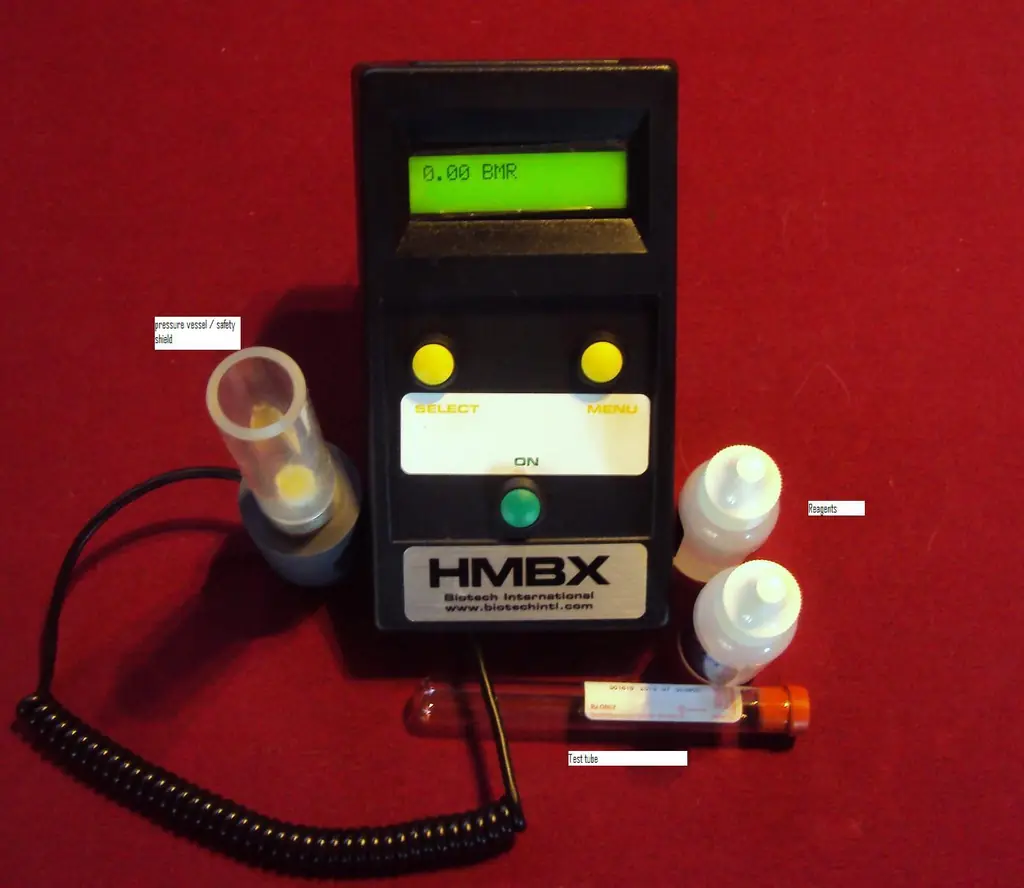
BioTech's HMB X handheld tester exists because of this exact gap. Instead of sending a sample to grow on a plate for one to three days and finding out Thursday what was true Monday, it reads biological activity directly, right at the machine, in about fifteen minutes. It works by measuring the peroxidase enzymes that aerobic organisms give off while metabolizing; the reagent reacts with that peroxidase, the instrument reads the oxygen produced, and converts it into a Biomass Range reading you can act on right away.
That's a genuinely different kind of information than a plate count. A plate count tells you how many organisms were present in the sample when you took it, once the colonies have had time to grow out. A BMR reading tells you how active the population is right now. For a sump that goes bad over a weekend, "right now" is the number that actually helps, because it lets you catch the climb on Wednesday instead of finding the aftermath on Monday.
BioTech built the HMB X to be used by someone with little or no laboratory background, which matters here. A maintenance supervisor checking a dozen sumps before a long weekend doesn't have time to run cultures and doesn't need a microbiology degree to read a number and decide whether a given sump needs attention before the doors lock on Friday.
What's actually at stake
Bacterial contamination in metalworking fluids isn't just an odor problem. It's associated with corrosion, reduced tool life, and operator health concerns, on top of the smell that makes a shop unpleasant to walk into on a Monday. Catching the climb early, before the weekend does the rest of the work, is the difference between a five-minute adjustment on Wednesday and a full sump dump on Monday.
None of this requires guessing. It requires testing on a schedule that fits how the sump actually behaves, including the days it sits idle, rather than a schedule built around how long a lab result takes to come back.
A three-day weekend is worse than a two-day one for exactly this reason, and a shutdown over a holiday week worse still. Every extra day of stillness is another day of warming, another day of oxygen depletion, another day for the population that was already climbing to keep climbing undisturbed. A shop that's fine on a normal Monday can still come back to a genuinely bad sump after a long weekend, not because anything changed about the fluid, but because the shutdown ran longer than usual.
The fix isn't complicated once you see the pattern. Test before a scheduled shutdown, not just after one. A reading taken Friday afternoon tells you whether the sump is already climbing toward trouble before it sits for two or three days with nobody watching it. Catching a rising number on Friday, while a dose or an adjustment is still a same-shift fix, beats catching a rancid sump on Monday, when the only options left are more drastic and more expensive.
BioTech International, Inc., (281) 750-1881
Call (281) 750-1881More articles
Activity vs Counts: What a Plate Count Actually Tells You
Two shops running the same coolant can get two different answers depending on which test they ran, and neither one is wrong.
The Sawtooth and the Sine Wave
One coolant maintenance program climbs and crashes on a schedule. The other runs flat. The shapes tell you almost everything.